What is Bioinformatics?

Introduction
If you're reading this, you're either:
- A bioinformatician (you know what you're doing)
- Some kind of wet lab researcher who heard about bioinformatics
- A student who is interested in going into the field and doesn't know where to start
- A concerned parent who heard that their kid wants to go into the field
And this is a topic that I often run into daily when meeting new people. The conversation also goes like this:
"What do you do?"
"I'm a bioinformatician."
"Okay, what's that?"
That's a tough question to answer, but an exciting one to answer. Let's see how well Wikipedia answers this question:
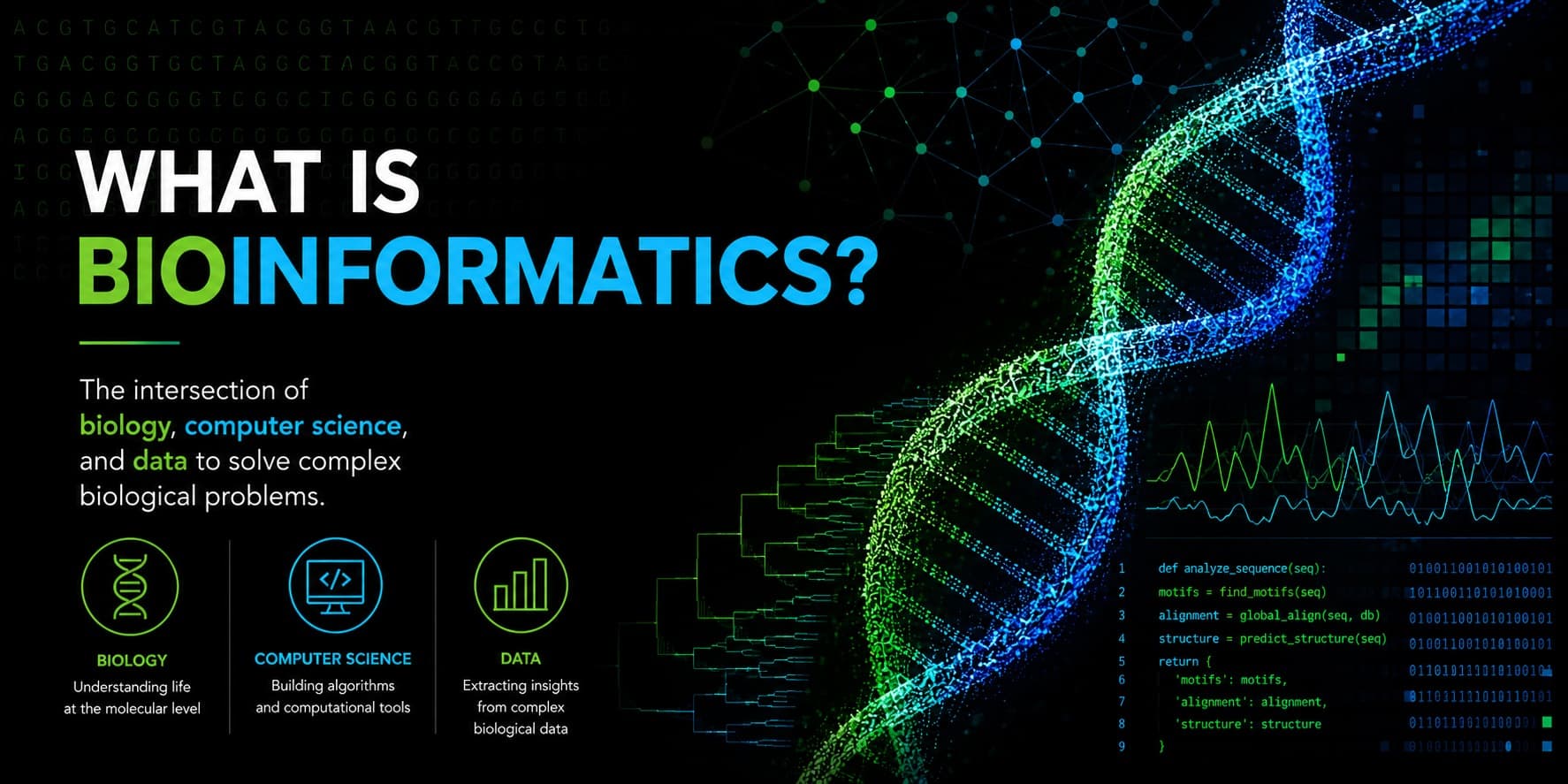
Bioinformatics is an interdisciplinary field of science that develops computational methods and software tools for understanding biological data, especially when data sets are large and complex.
Source: Wikipedia
I don't know about you, but I don't find that answer particularly satisfying. Sure, you could go in depth browsing through the Wikipedia article, but for 90% of people not in the field (particularly those not in research), this is all going to go straight over there head.
Historically, my solution has been to answer the question with, "We just apply ideas from data science, statistics, and software engineering to understand biological data."
And that's the answer I still use to this day. It's my general answer that works to answer the question for every person I've ever met. And then the conversation moves on from there. But it doesn't answer the question - why does the work of bioinformaticians matter?
Why Does Bioinformatics Matter?
One of the most distinctive features of bioinformatics is its interdisciplinary nature. It covers multiple domains of knowledge that had no intersection even as far back as the 1970s. Alongside with the intrinstically intimidating term, the public has not fully grasped the implication of the field and its role in their day-to-day lives. As a result, the field has been largely compartmentalized into roles that have more cultural and practical impact:
- Biostatistics
- Computational Biology
- Biological Data Science Engineering
- Genomics
- Genetics
- Proteomics
Bioinformatics is the intersection of all of these and so much more: any type of computational task that can be applied to biological data falls under the umbrella of bioinformatics.
Bioinformatics is a term coined in 1970 by Dutch theoretical biologists Paulien Hogeweg and Ben Hesper - they intended to use the word to describe "the study of informatic processes in biotic systems" (Source: NIH).
And why do we need to study informatic processes in biotic systems?
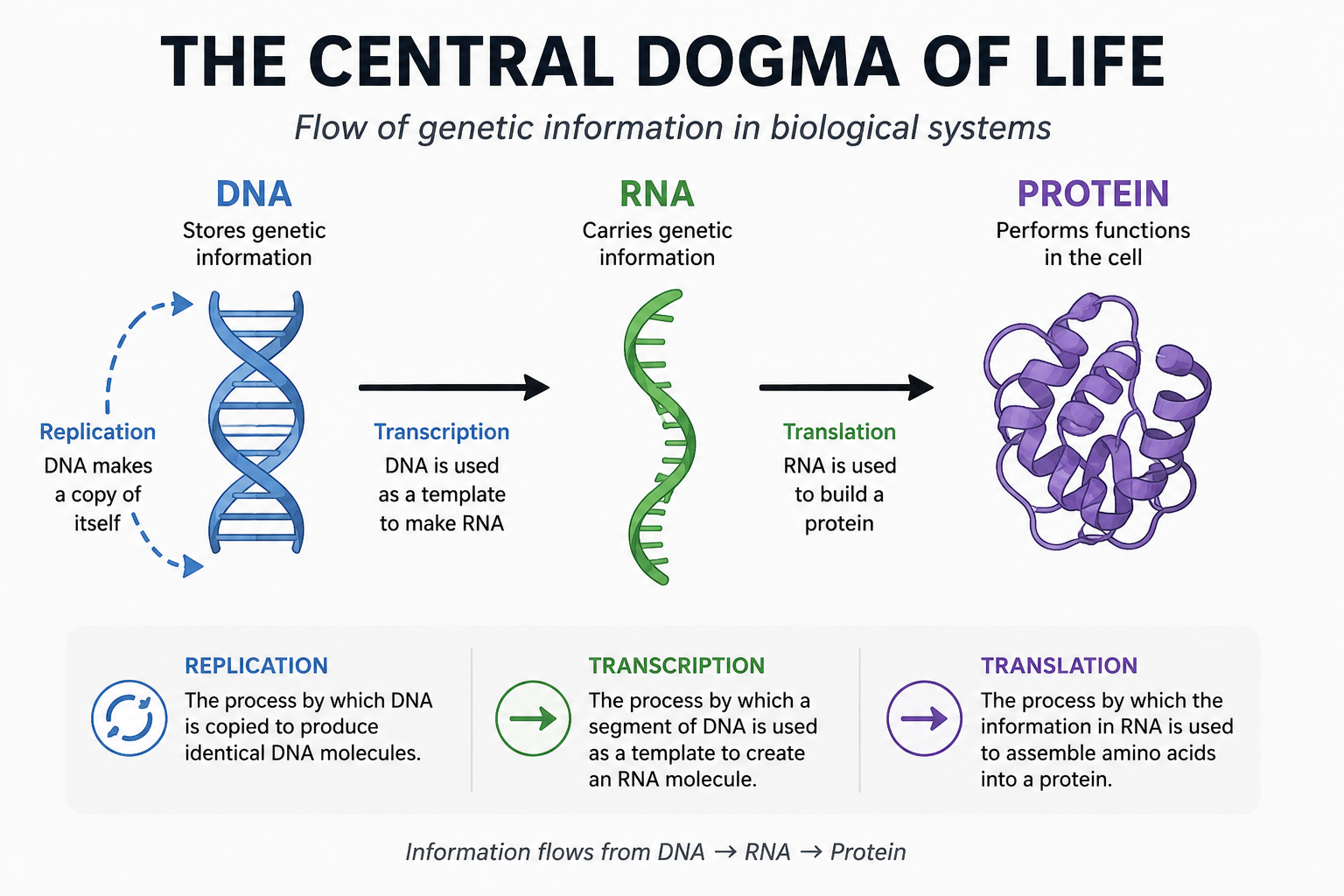
This is the central dogma of all biological life - every single biological process that we learn or talk about in the field of biology uses this single pathway as a hub. The one takeaway to understand about the central dogma of biology is that at its core it is a simply a flow of information. A message encoded in molecules that flow to write out how a single organism might look or behave, how cells respond to the environment, and how parents share their genetic information to their children.
Understanding that all life is simply the handing off of information from one medium to another is the core of bioinformatics. Believe me, even in the minute that you were reading this, there is a lot of information to handle.